
Introduction
Welcome to this Beginner’s Guide to SEO. Have you ever wondered why some websites always appear on the first page of Google while others are almost impossible to find? The answer is SEO, which stands for Search Engine Optimization.
Whether you’re a blogger, business owner, digital marketer, freelancer, or someone curious about how Google works, learning SEO is one of the most valuable skills you can develop. Good SEO helps your website attract the right audience without paying for every visitor through ads.
The best part? You don’t need to be a programmer or an expert to understand SEO. Once you learn the basics, you’ll see how search engines discover websites, rank pages, and decide which content deserves to appear at the top of search results.
In this beginner’s guide, you’ll learn what SEO is, how it works, why it’s important, the different types of SEO, and the first steps you should take to start your SEO journey with confidence.
What Is SEO? (A Beginner's Guide to SEO)
SEO stands for Search Engine Optimization. It is the process of improving a website so that search engines like Google can understand its content and show it to people searching for relevant information.
Imagine you own a bakery. If someone searches for “best chocolate cake near me,” you would want your website to appear on the first page of Google. SEO helps increase the chances of that happening.
Unlike paid advertisements, SEO focuses on organic traffic, which means visitors come to your website naturally through search results instead of clicking on ads.
SEO is not about tricking Google. Instead, it’s about creating useful, high-quality content, improving your website’s technical performance, and providing a great experience for users.
Think of SEO as helping both search engines and people understand your website better. When your content is relevant, trustworthy, and easy to access, search engines are more likely to recommend it to users.
How Does SEO Work?
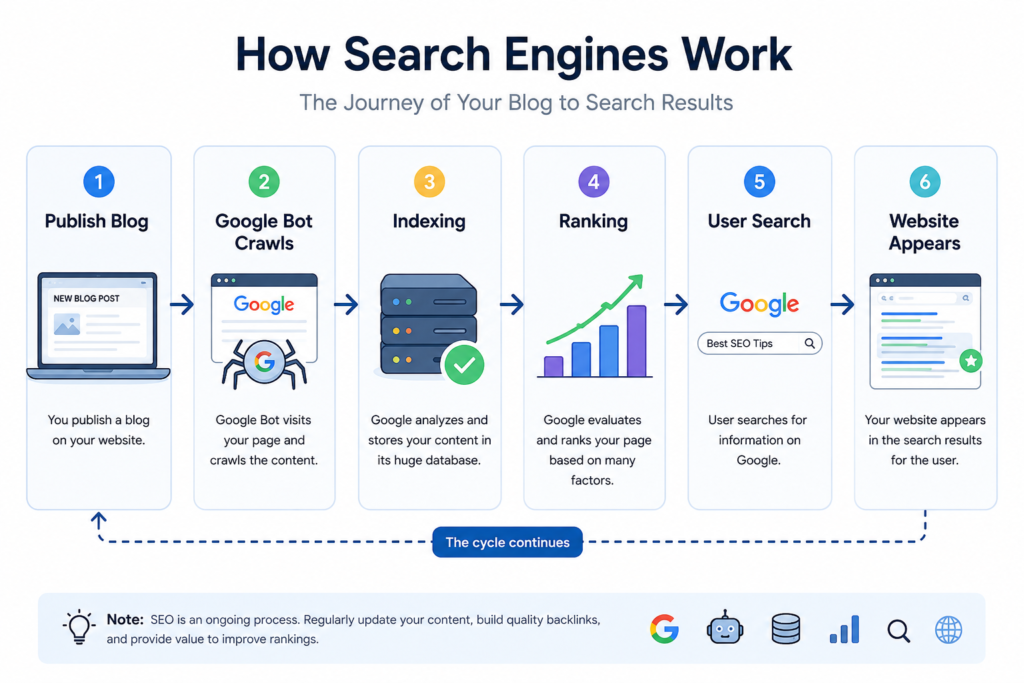
When we publish a blog, Google doesn’t show it in search results immediately. First, it needs to understand what the page is about. To do this, Google sends automated programs called bots or crawlers to visit the website.
These crawlers scan the page and analyze its content, images, links, and other important information. This process is known as crawling. It helps Google discover new pages and identify any updates made to existing ones.
After crawling, Google stores the collected information in its massive database, called the Google Index. You can think of it like placing a new book on the shelf of a huge digital library. This process is called indexing.
Once a page has been indexed, it becomes eligible to appear in Google Search. When someone searches for a keyword or asks a question, Google doesn’t search the entire internet in real time. Instead, it looks through its index and decides which pages are the most relevant to the user’s query.
Google ranks pages based on hundreds of factors, including content quality, keyword relevance, website speed, backlinks, mobile-friendliness, and user experience. Pages that provide the most helpful and trustworthy information are more likely to appear higher in the search results.
In simple terms, SEO works in three main steps:
- Crawling – Google discovers your website and its pages.
- Indexing – Google stores your pages in its database.
- Ranking – Google decides where your page should appear in search results.
Understanding these three steps is the foundation of SEO. If Google can’t crawl or index your website, it won’t be able to rank it, no matter how good your content is.
Why Is SEO Important?
Millions of businesses around the world sell similar products and services. However, when people search on Google, they usually click on the websites that appear on the first page, especially the top few results. Websites that rank lower often receive very little traffic, even if they offer products of the same quality.
This is why SEO is so important. It helps websites improve their visibility in search results, making it easier for potential customers to discover their business.
Unlike paid advertising, SEO focuses on attracting organic traffic, which means visitors come to your website naturally through search engines without paying for every click. While SEO takes time and consistent effort, it can deliver long-term results and reduce the need for expensive advertising campaigns.
A well-optimized website not only attracts more visitors but also builds trust and credibility. When users repeatedly see a website ranking high on Google, they are more likely to consider it reliable and authoritative.
For bloggers, businesses, and content creators, SEO is one of the most effective ways to grow online. It helps increase website traffic, generate leads, improve brand awareness, and support long-term business growth.
The 4 Types of SEO
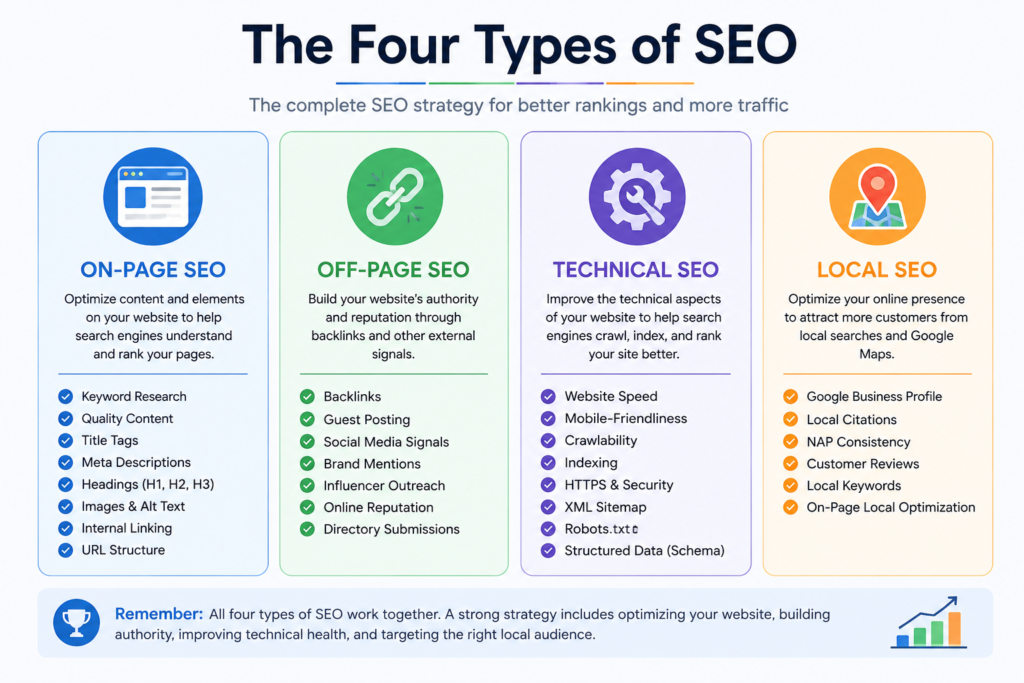
SEO is generally divided into four main types. Each type focuses on a different aspect of improving a website’s visibility in search results. Together, they help search engines understand your website and provide a better experience for users.
1. On-Page SEO
On-Page SEO includes all the optimization work done inside a webpage. This includes writing high-quality content, optimizing titles, meta descriptions, headings, images, internal links, and naturally using relevant keywords.
Think of it like owning a café. You clean the space, play the right music, improve the atmosphere, and make sure customers have a great experience. If customers don’t enjoy something, you improve it. Similarly, On-Page SEO focuses on improving everything inside your website to provide the best possible experience for both users and search engines.
2. Off-Page SEO
Off-Page SEO refers to all the activities performed outside your website to improve its authority and reputation. The most common example is earning backlinks from other websites, but brand mentions, online reviews, and social sharing also contribute.
Imagine your café has happy customers who recommend it to their friends or leave positive reviews online. Even though these actions happen outside your café, they increase your reputation and attract more visitors. Off-Page SEO works in the same way by building trust and authority across the web.
3. Technical SEO
Technical SEO focuses on improving the technical performance of a website so that search engines can easily access, understand, and rank its pages. It includes improving website speed, making the site mobile-friendly, fixing technical errors, and ensuring that search engines can crawl and index the website properly. A technically healthy website provides a better experience for both users and search engines.
4. Local SEO
Local SEO helps businesses appear in location-based searches. It is especially important for businesses that serve customers in a specific city or area.
For example, if someone searches for “Digital Marketing Institute near me” or “best café in Amritsar,” Google tries to show the most relevant local businesses. Creating and optimizing a Google Business Profile, collecting customer reviews, and maintaining accurate business information all play an important role in Local SEO.
Keyword Research Basics
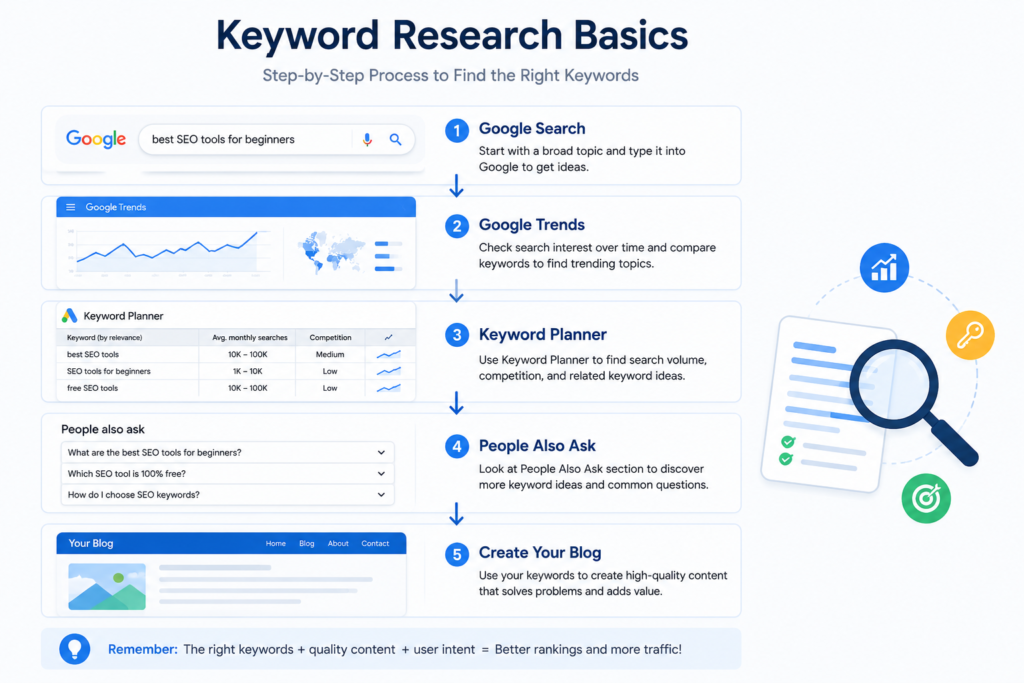
Keyword research is the process of finding the words and phrases that people type into search engines like Google to find information or answers to their questions. Instead of guessing what users are searching for, keyword research helps us understand their interests and create content that matches their search intent.
Choosing the right keyword is one of the most important steps in SEO. Even a well-written article may struggle to rank if it targets a keyword that nobody searches for. By selecting relevant keywords, you increase the chances of reaching the right audience and attracting organic traffic.
There are many tools available for keyword research, including Google Trends, Google Keyword Planner, Google Search Suggestions, People Also Ask, and Related Searches. These tools help you discover popular search terms, understand user intent, and identify topics that people are actively looking for.
Before writing this blog, I also performed keyword research using Google Trends, Google Search Suggestions, People Also Ask, and Related Searches. This helped me understand what beginners were searching for and allowed me to structure this guide around their most common questions.
How to Start Learning SEO as a Beginner
Starting SEO may seem overwhelming at first, but you don’t need to learn everything in one day. The best approach is to build a strong foundation and learn one concept at a time. As your knowledge grows, you’ll naturally understand how different parts of SEO work together.
Begin by understanding the basics of SEO and how search engines discover, index, and rank web pages. Once these concepts are clear, move on to learning keyword research, as it helps you understand what people are searching for and what kind of content you should create.
The next step is to practice On-Page SEO by learning how to optimize titles, headings, meta descriptions, images, internal links, and content. After that, explore Off-Page SEO to understand how backlinks and website authority influence search rankings.
Once you’re comfortable with these fundamentals, learn the basics of Technical SEO to ensure your website is fast, mobile-friendly, and easy for search engines to crawl and index. You should also become familiar with tools like Google Search Console and Google Analytics, which help you monitor your website’s performance and identify areas for improvement.
Finally, the best way to learn SEO is through practice. Create your own website, publish helpful content consistently, and apply what you learn. SEO is a skill that improves with experience, and every blog you write teaches you something new.
How to Do SEO Step by Step
If you’re new to SEO, you don’t need to know everything or be perfect before getting started. SEO is a long-term process, and the best way to learn is by taking one step at a time. Here’s a simple step-by-step roadmap to help you get started.
Step 1: Choose the Right Keyword
Every successful SEO strategy begins with keyword research. Before writing any content, find out what people are actually searching for on Google. Use tools like Google Trends, Google Keyword Planner, Google Search Suggestions, and People Also Ask to discover relevant keywords. Choosing the right keyword helps you create content that matches what users are looking for.
Step 2: Understand the Search Intent
Finding a keyword is only the first step. You also need to understand why people are searching for it. Are they looking for information, comparing products, planning to make a purchase, or searching for a specific website? Understanding search intent helps you create content that answers the user’s needs.
Step 3: Write Helpful, High-Quality Content
Once your research is complete, create content that is useful, accurate, and easy to understand. Naturally include your primary keyword and relevant secondary keywords, but avoid keyword stuffing. Always focus on solving the user’s problem rather than writing only for search engines.
Step 4: Optimize Your Page (On-Page SEO)
After writing your content, optimize every important element on the page. Write an engaging title, add a clear meta description, use proper headings (H1, H2, and H3), optimize images with descriptive alt text, and include internal links where relevant. These improvements help both users and search engines understand your content.
Step 5: Ensure Your Website Is Technically Healthy
A well-written article may still struggle to rank if the website has technical issues. Make sure your website loads quickly, works well on mobile devices, is secure, and provides a smooth user experience. A technically healthy website makes it easier for search engines to crawl, index, and rank your pages.
Step 6: Build Authority with Off-Page SEO
Once your website is optimized, focus on building its authority outside your website. One of the most effective ways is by earning high-quality backlinks from trusted websites. You can also improve your online reputation through guest posting, brand mentions, social media sharing, and positive customer reviews. These signals help search engines see your website as more trustworthy and authoritative.
Step 7: Track Your Performance
SEO doesn’t end after publishing a blog. Use tools like Google Search Console and Google Analytics to monitor your website’s performance. Track important metrics such as impressions, clicks, rankings, traffic, and user behavior to understand what’s working and where improvements are needed.
Step 8: Keep Improving Your Content
SEO is an ongoing process, not a one-time task. Regularly update your content, improve outdated information, add new insights, and refine your SEO strategy based on performance data. Consistent improvements help your content stay relevant and competitive over time.
Best SEO Tools for Beginners
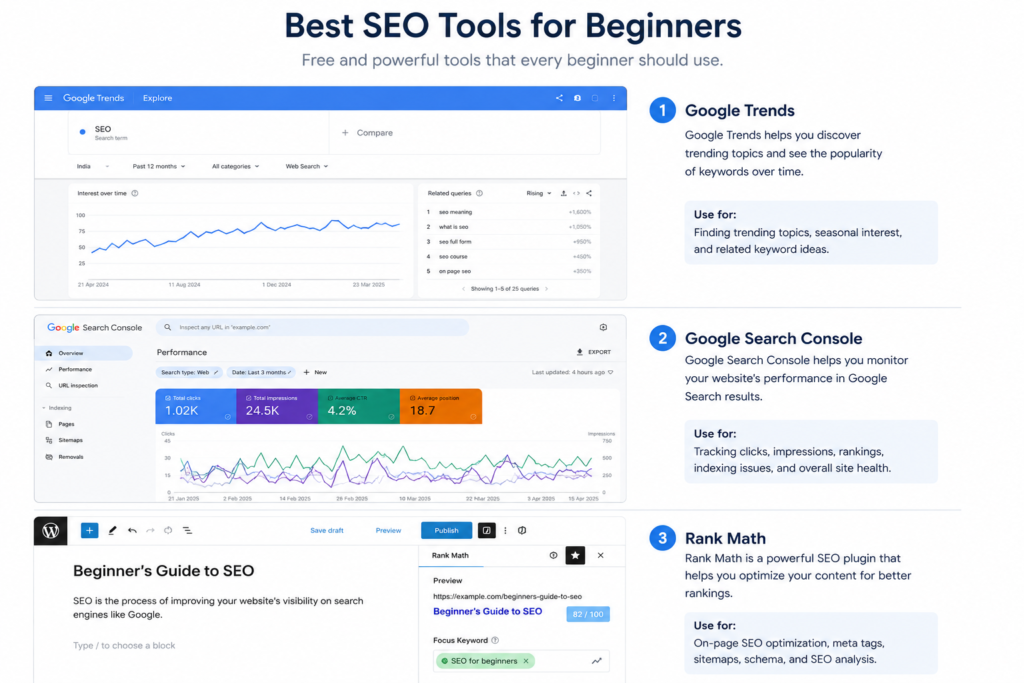
SEO becomes much easier when you use the right tools. Fortunately, many beginner-friendly tools are available for free and can help you research keywords, optimize your website, and track its performance.
Google Trends
Google Trends helps you discover trending topics and keywords that people are currently searching for. It is useful for finding popular content ideas and understanding how search interest changes over time.
Google Keyword Planner
Google Keyword Planner helps you discover new keywords, estimate their search volume, and understand the level of competition. It is a great tool for planning your content strategy and choosing relevant keywords.
Google Search Console
Google Search Console helps you monitor your website’s presence in Google Search. It shows which keywords bring visitors to your website, how your pages are performing, whether they are indexed, and if there are any technical issues affecting your SEO.
Google Analytics
Google Analytics helps you understand how visitors interact with your website after they arrive. It provides valuable insights into traffic sources, user behavior, page views, session duration, and many other performance metrics.
Rank Math
Rank Math is a popular WordPress SEO plugin that helps optimize your content for search engines. It provides suggestions for improving on-page SEO, readability, meta tags, image optimization, and many other SEO elements.
WordPress
WordPress is one of the world’s most popular content management systems (CMS). It allows you to create, manage, and optimize websites without writing code, making it an excellent choice for beginners learning SEO.
Common SEO Mistakes to Avoid
When you’re just starting with SEO, it’s normal to make mistakes. However, avoiding a few common mistakes can save you time and help your website grow more effectively. Here are some of the most common SEO mistakes beginners should avoid.
1. Skipping Keyword Research
Many beginners start writing content without checking what people are actually searching for. Always perform keyword research before creating a blog or webpage to ensure your content matches user interest.
2. Ignoring Search Intent
Choosing the right keyword is not enough. You also need to understand why people are searching for it. Your content should answer the user’s question or solve their problem.
3. Keyword Stuffing
Repeating the same keyword over and over does not improve rankings. Instead, it makes your content difficult to read and may negatively affect your SEO. Use keywords naturally throughout your content.
4. Publishing Low-Quality Content
Creating content just to publish more articles is a common mistake. Focus on writing helpful, accurate, and original content that provides real value to your readers.
5. Ignoring On-Page SEO
Many beginners forget to optimize titles, meta descriptions, headings, image alt text, and internal links. These small improvements help search engines understand your content better.
6. Overlooking Technical SEO
A slow website, poor mobile experience, or technical issues can affect your rankings. Make sure your website is fast, mobile-friendly, and easy for search engines to crawl and index.
7. Not Tracking Your Website’s Performance
SEO is an ongoing process. Use tools like Google Search Console and Google Analytics to monitor your website’s performance, identify issues, and measure your progress.
8. Expecting Instant Results
One of the biggest mistakes beginners make is expecting their website to rank overnight. SEO takes time, consistency, and continuous improvement. Be patient, keep learning, and focus on creating valuable content.
The Future of SEO: AI, GEO & AEO
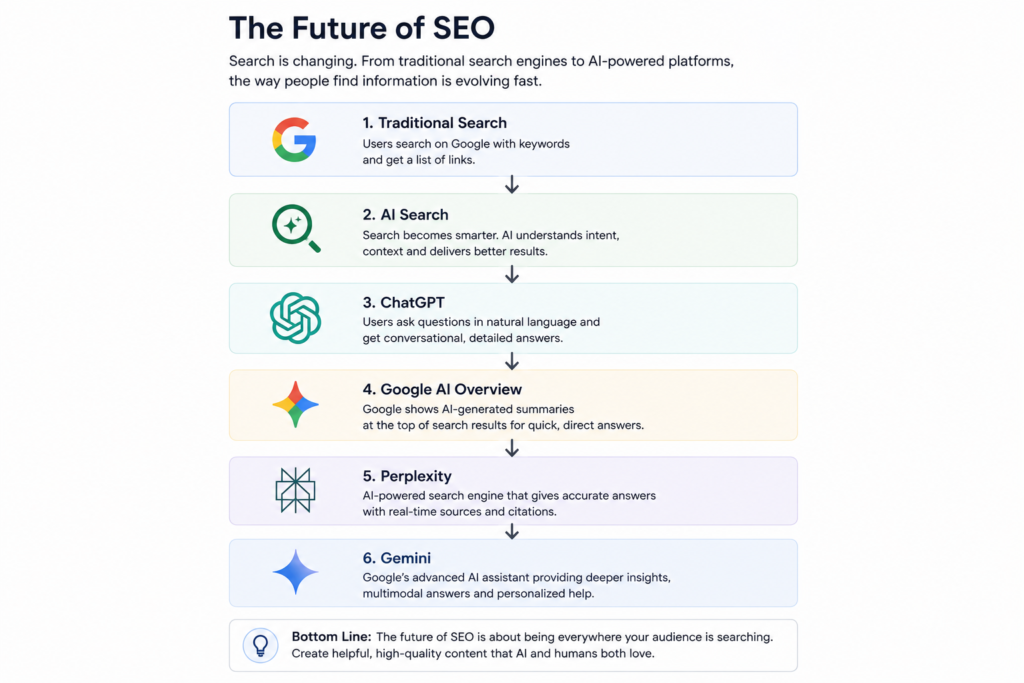
SEO is constantly evolving, and the way people search for information is changing rapidly. While traditional Google Search remains important, AI-powered search engines and assistants are becoming a bigger part of how users discover content. As a result, modern SEO is no longer just about ranking on Google—it is also about making your content easy for AI systems to understand and recommend.
AI in SEO
Artificial Intelligence (AI) has transformed the way SEO professionals research keywords, create content, optimize websites, and analyze performance. AI tools can help speed up many tasks, but they should be used to support human creativity rather than replace it. High-quality, original, and trustworthy content continues to perform better in the long run. If you’d like to learn more about balancing AI with authentic writing, read our article, AI Content Is Everywhere… Still Authentic Content Wins.
GEO (Generative Engine Optimization)
Generative Engine Optimization (GEO) focuses on optimizing content for AI-powered search engines and generative AI platforms. Instead of only ranking on a list of search results, the goal is to create content that AI systems can understand, summarize, and recommend when answering users’ questions.
AEO (Answer Engine Optimization)
Answer Engine Optimization (AEO) is the practice of creating content that directly answers users’ questions in a clear and structured way. As more people use AI assistants and voice search, content that provides concise, accurate, and well-organized answers has a better chance of being featured in AI-generated responses.
The Future Is About Helping Users
Whether it’s traditional SEO, GEO, or AEO, one principle remains the same: create content that genuinely helps people. Search engines and AI systems are becoming better at understanding user intent, which means helpful, accurate, and trustworthy content will continue to have the greatest long-term value. Although GEO and AEO are still emerging concepts, they are becoming increasingly important as AI-powered search continues to evolve. Learning traditional SEO first provides a strong foundation for adapting to these new optimization strategies.
What's Next in Your SEO Journey?
Congratulations! You’ve taken the first step toward learning Search Engine Optimization. In this guide, you learned what SEO is, how search engines work, why SEO matters, the four types of SEO, keyword research, search intent, the basic SEO workflow, beginner-friendly tools, common mistakes to avoid, and how AI is influencing the future of search.
However, this is only the beginning. SEO is a vast field, and each topic deserves a deeper explanation. In the upcoming articles of this series, we’ll explore every major SEO concept step by step with practical examples and real-world implementation.
Here’s what we’ll cover next:
- On-Page SEO: Learn how to optimize titles, headings, meta descriptions, images, URLs, and content for better rankings.
- Off-Page SEO: Understand backlinks, link building, domain authority, anchor text, and how to build website authority.
- Technical SEO: Discover how to improve website speed, mobile-friendliness, indexing, crawlability, and technical performance.
- Keyword Research: Learn how to find the right keywords using free and paid SEO tools.
- Google Search Console: Understand how to monitor your website’s performance, indexing status, and search visibility.
- Google Analytics: Learn how to analyze visitor behavior and measure your website’s growth.
Remember, SEO is not about finding shortcuts or tricks to rank quickly. It’s about creating valuable content, understanding your audience, and continuously improving your website. With patience, consistency, and regular practice, you’ll develop skills that can help you grow websites, build an online presence, and even create a successful career in digital marketing.
We hope this Beginner’s Guide to SEO has given you a strong foundation to start your learning journey. Keep practicing, stay curious, and continue exploring the upcoming articles in this SEO series. Thank you for reading, and we’ll see you in the next chapter.
Asked Questions (FAQs)Frequently
1. What is SEO and how does it work?
SEO (Search Engine Optimization) is the process of improving a website’s visibility on search engines like Google. It works by helping search engines crawl, index, and understand your content so they can show it to users searching for relevant information. High-quality content, keyword optimization, technical performance, and backlinks all contribute to better search rankings.
2. What are the four types of SEO?
The four main types of SEO are:
- On-Page SEO – Optimizing content, titles, headings, images, and meta descriptions.
- Off-Page SEO – Building website authority through backlinks, brand mentions, and online reputation.
- Technical SEO – Improving website speed, mobile-friendliness, security, and crawlability.
- Local SEO – Optimizing a business to appear in location-based searches, such as “restaurants near me.”
Each type plays an important role in improving a website’s visibility in search results.
3. Can ChatGPT help with SEO?
Yes, ChatGPT can help with many SEO tasks, including brainstorming content ideas, creating blog outlines, improving readability, writing meta descriptions, suggesting keywords, and explaining SEO concepts. However, it should be used as a support tool, not a replacement for keyword research, real-world testing, or human expertise. Successful SEO still requires creating original, accurate, and helpful content for users.
4. Is SEO an IT skill?
Not necessarily. SEO is primarily a digital marketing skill, although some areas—especially Technical SEO—require a basic understanding of websites and web technologies. Beginners can learn SEO without a programming background, and many SEO tasks can be performed using tools like WordPress, Google Search Console, and Rank Math without writing code.