
What Is Off-Page SEO?
Off-Page SEO refers to the activities and external signals that happen outside your own website to improve its visibility, reputation, authority, and search engine performance. Unlike On-Page SEO, which focuses on optimizing elements within your website, Off-Page SEO focuses on how your website is connected with the wider web.
For example, when another relevant website links to one of your blog posts, it creates a backlink to your website. Other activities, such as brand mentions, guest blogging, digital PR, and business citations, can also be part of Off-Page SEO.
The main idea behind Off-Page SEO is to build your website’s credibility beyond your own pages. When other relevant and trustworthy sources reference or mention your website, these external signals can help search engines better understand your website and its content.
However, Off-Page SEO is not simply about getting as many links as possible. The quality, relevance, and context of external signals matter, which is why a thoughtful Off-Page SEO strategy focuses more on building genuine authority than collecting large numbers of links.
Why Is Off-Page SEO Important?
Off-Page SEO is important because search engines do not only look at what happens on your website. They can also use external signals to better understand a website’s reputation, relevance, and authority.
One of the most important external signals is a backlink from another website. When a relevant and trustworthy website references your content, it can help build credibility and show that your website is connected to other useful resources within the same topic.
Off-Page SEO can also help increase your website’s visibility. For example, when another website mentions or links to your content, its audience may discover your website and visit your pages. This can help your content reach people beyond your existing audience.
However, Off-Page SEO is not about collecting as many links as possible. Relevance, quality, and context matter. A few useful links from relevant and trustworthy websites can be more valuable than a large number of irrelevant or spammy links.
Overall, Off-Page SEO helps build a stronger presence for your website beyond its own pages. When combined with good content and effective On-Page SEO, it can support your website’s long-term growth in search.
How Does Off-Page SEO Work?
Off-Page SEO works by building signals about your website outside of your own pages. These signals can come from backlinks, brand mentions, references, and other external activities that help search engines understand your website’s relevance and reputation.
For example, imagine you publish an article about On-Page SEO. If several relevant websites reference that article and link to it because they find it useful, search engines can discover these external connections and consider them alongside other SEO factors.
However, search engines do not simply count the number of backlinks a page receives. The relevance, quality, context, and naturalness of those links can matter when evaluating external signals. This means having a large number of irrelevant or low-quality links does not automatically make a website’s Off-Page SEO stronger.
The goal of Off-Page SEO is therefore not to collect as many links as possible. Instead, it is about building genuine connections, earning relevant references, and creating a trustworthy presence across the web.
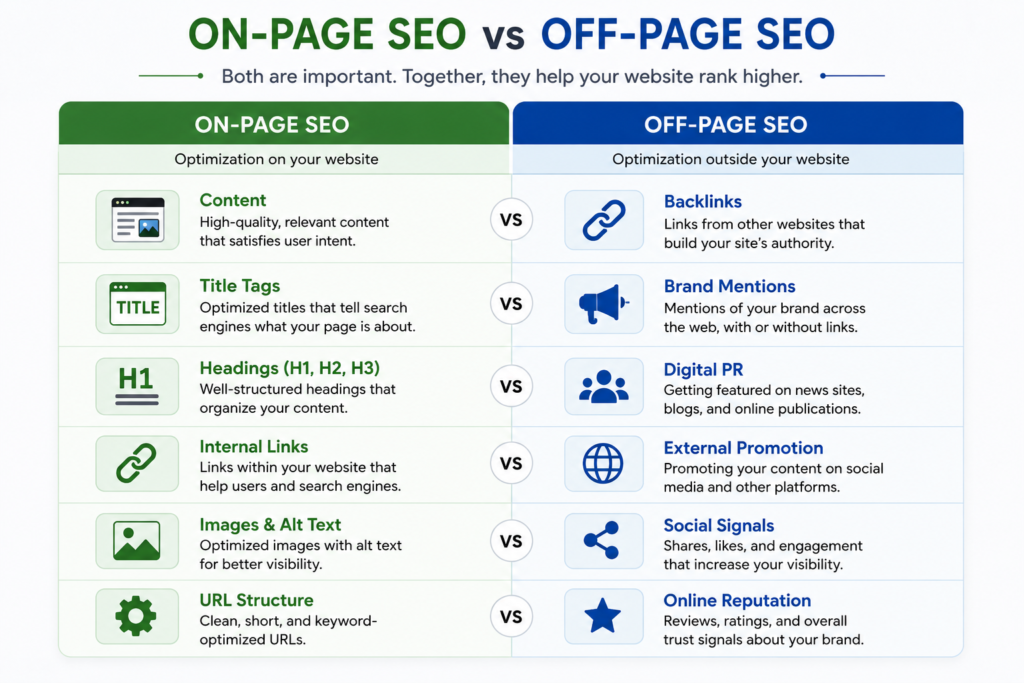
Off-Page SEO vs On-Page SEO
On-Page SEO and Off-Page SEO both aim to improve a website’s search visibility, but they focus on different areas.
On-Page SEO focuses on optimizing elements within your own website. This includes creating useful content, optimizing title tags and meta descriptions, using relevant keywords, improving headings, adding internal links, and optimizing images.
Off-Page SEO, on the other hand, focuses on activities and signals outside your website. These can include earning backlinks, building brand mentions, guest blogging, digital PR, and other activities that help establish your website’s reputation and authority across the web.
A simple way to remember the difference is:
On-Page SEO = What you optimize on your website.
Off-Page SEO = What happens and what you build outside your website.
Both are important parts of SEO. Good On-Page SEO helps search engines understand your content, while Off-Page SEO can help build your website’s credibility, reputation, and authority beyond its own pages.
What Are Backlinks?
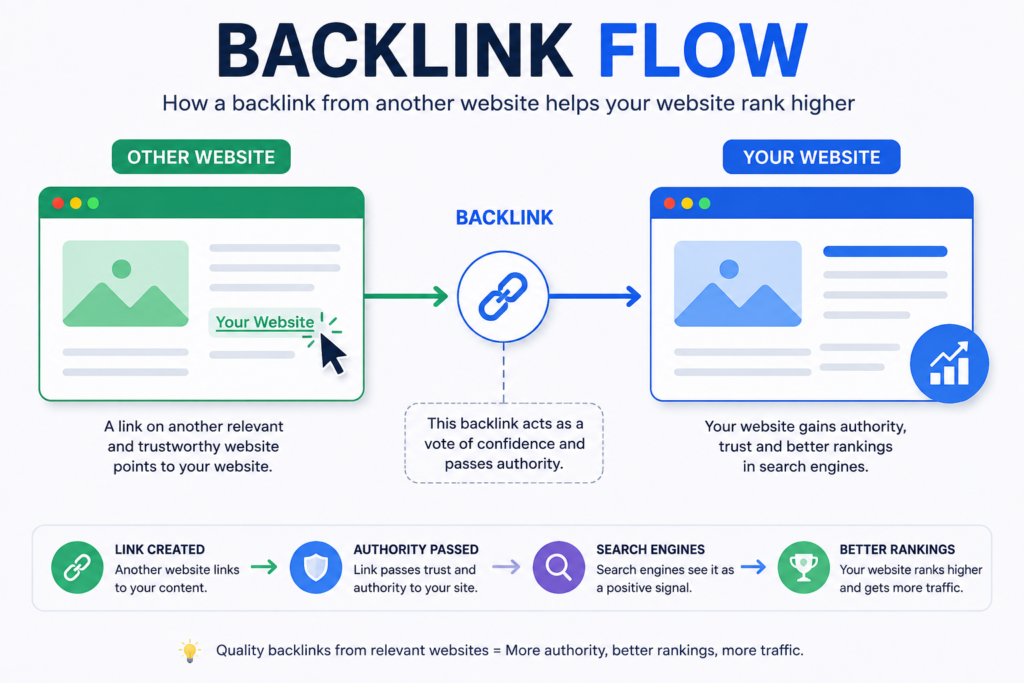
Backlinks are one of the most important parts of Off-Page SEO. A backlink is a link from one website to another website or webpage. In simple words, when another website links to your website, you receive a backlink.
For example, if another website links to your article about On-Page SEO, that link is a backlink to your specific article. Backlinks are not limited to the homepage. Other websites can link directly to any useful page or blog post on your website.
What Is a Backlink?
A backlink is simply a link that comes from another website to your website or one of its pages.
For example:
Other Website → Your Website
If another website links directly to your article:
Other Website → Your Article
then that specific article receives a backlink.
Backlinks can be useful because they create connections between websites and can help search engines discover and understand relationships between different pages across the web.
What Makes a Backlink Valuable?
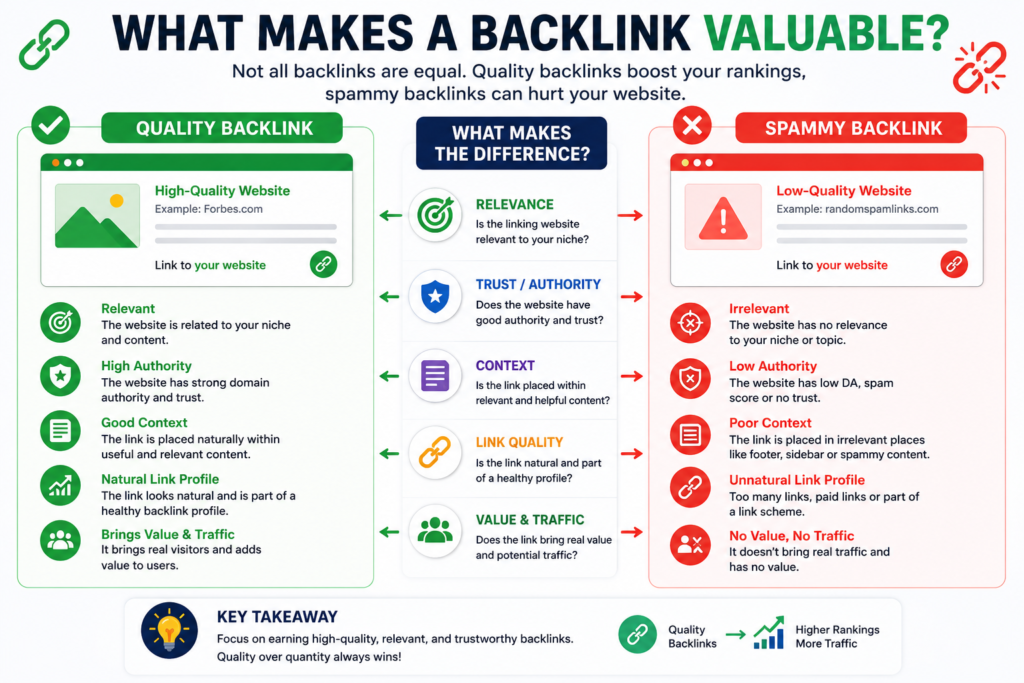
Not every backlink has the same value. The number of backlinks alone does not determine whether a website has a strong Off-Page SEO strategy.
A backlink can be more valuable when it comes from a relevant and trustworthy website and is placed naturally within useful content. Relevance is especially important because a link from a website related to your topic can make more sense than a random link from an unrelated website.
For example, a link to your SEO article from a relevant SEO or digital marketing website is more contextually relevant than a random link from a completely unrelated website.
This is why the goal should not be to collect as many backlinks as possible. Instead, focus on earning relevant, useful, and natural backlinks.
DoFollow vs NoFollow Links
When SEO professionals talk about a “DoFollow” backlink, they usually mean a normal link that does not have a rel=”nofollow” attribute.
A normal followed link can be considered by search engines for link-related signals.
A NoFollow link uses the rel=”nofollow” attribute. It tells search engines that the link should not be treated as a normal editorial endorsement for ranking purposes.
However, a NoFollow link is not useless. People can still click it, visit your website, discover your content, and become familiar with your brand.
So, both types of links can bring traffic and visibility, but they can be treated differently by search engines for ranking-related purposes.
What Is Anchor Text?
Anchor text is the clickable text that contains a hyperlink.
For example, if you write:
Learn more about On-Page SEO.
and add a link to your On-Page SEO article on the words “On-Page SEO”, then “On-Page SEO” is the anchor text.
Anchor text can be used for both internal links and backlinks. When you link to another article on your own website, it is an internal link. When another website links to your page, it is a backlink. In both cases, the clickable words used for the link are called anchor text.
Using clear and relevant anchor text helps readers understand what they can expect when they click the link.
What Is Link Building?
Link building is the process of getting or earning backlinks from other websites. It is an important part of Off-Page SEO because backlinks can help build connections between your website and other websites across the web.
For example, if you publish an article about Off-Page SEO and another relevant website links to it, you receive a backlink. The activities you carry out to find opportunities and earn that backlink are part of link building.
In simple terms, a backlink is the result, while link building is the process of working towards earning backlinks.
However, link building is not about getting as many links as possible. Good link building focuses on earning relevant, useful, and natural links from websites that make sense for your topic. Creating spammy links, using automated methods, or trying to manipulate search rankings can be risky.
The goal of link building should be to create genuine connections and earn links because your content is useful and worth referencing.
Off-Page SEO Techniques
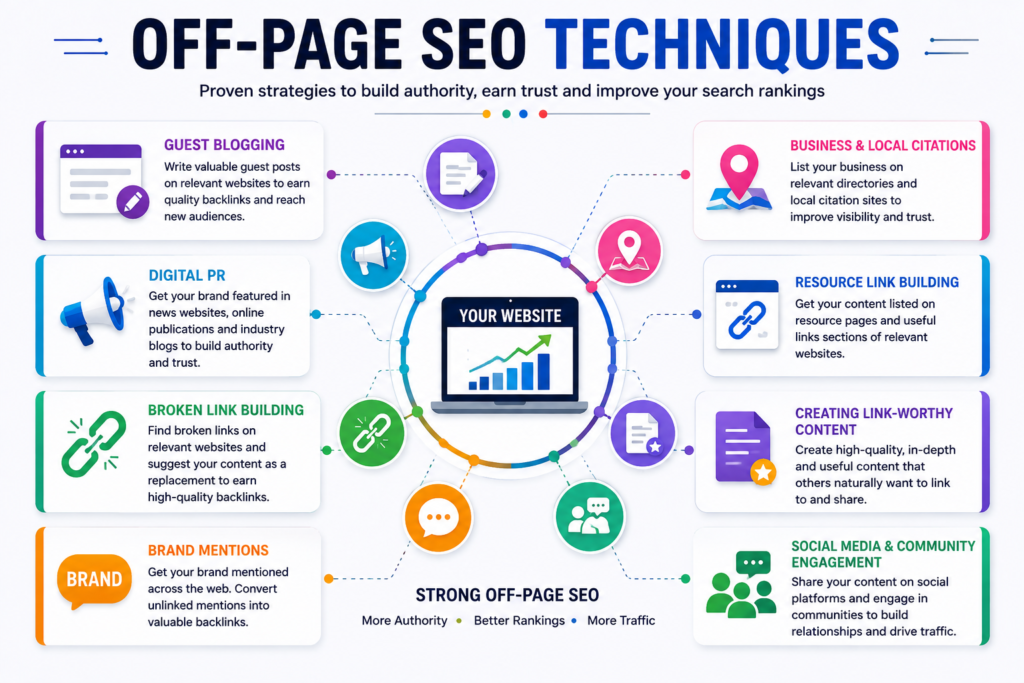
Off-Page SEO includes different activities that happen outside your website to improve its visibility, reputation, and presence across the web. Link building is an important part of Off-Page SEO, but it is not the only activity.
Some common Off-Page SEO techniques include:
Guest Blogging
Guest blogging means writing and publishing an article on another relevant website. If the website allows an appropriate link to your website, you may earn a backlink.
The main focus should be on creating useful content for the website’s audience rather than simply getting a backlink.
Digital PR
Digital PR involves promoting newsworthy content, original research, data, stories, or useful resources to online publications, journalists, and other media sources.
Good Digital PR can help you earn brand mentions, backlinks, referral traffic, and greater online visibility.
Broken Link Building
Broken link building involves finding broken links on relevant websites and suggesting your own useful resource as a possible replacement.
For example, if a website links to an old SEO guide that no longer exists, and you have a relevant guide that could help their readers, you can contact the website owner and suggest your resource.
Brand Mentions
A brand mention happens when another website or online platform mentions your brand, business, name, or website.
A mention does not always include a link. However, an unlinked brand mention can sometimes become a backlink opportunity if the website owner agrees to add a relevant link.
Business & Local Citations
Local citations are online mentions of a business’s important information, such as its name, address, phone number, and website.
They can appear on business directories, local websites, and other relevant platforms. Citations can be particularly useful for businesses that want to improve their local online presence.
Resource Link Building
Resource link building involves finding relevant resource pages or useful lists where your content could genuinely help the website’s audience.
You can suggest your useful guide, checklist, research, or other resource to the website owner. If they find it valuable, they may include it on their resource page and link to your website.
Creating Link-Worthy Content
Link-worthy content is content that gives other websites a genuine reason to reference or link to it.
This could include original research, useful guides, case studies, statistics, checklists, templates, tools, or unique insights.
Instead of focusing only on asking for backlinks, the goal is to create something that people naturally want to reference.
Social Media & Community Engagement
Social media and online communities can help increase your content’s visibility and reach new audiences.
You can share your content on relevant platforms and participate in discussions where you can genuinely help people. When appropriate, you can share your relevant resources as well.
Social media links do not necessarily work like traditional editorial backlinks, but social activity can still help generate visibility, traffic, brand awareness, and opportunities for people to discover and reference your content.
Off-Page SEO Tools
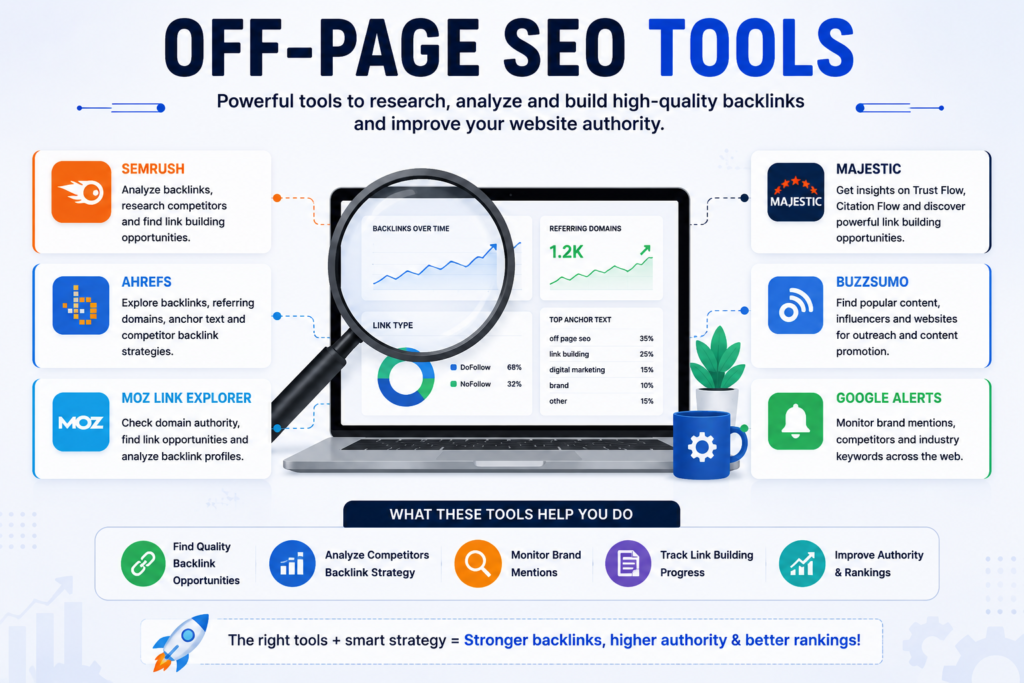
Off-Page SEO involves researching backlinks, analyzing competitors, finding link-building opportunities, and monitoring the backlinks your website earns. SEO tools can make these tasks much easier by providing useful data and insights.
Here are some useful tools for Off-Page SEO:
Google Search Console
Google Search Console is a free tool from Google that helps you monitor your website’s performance in Google Search. It also provides some information about websites that link to your site.
However, its backlink data is limited compared with dedicated SEO tools.
Ahrefs
Ahrefs is a popular SEO tool for backlink analysis and competitor research. You can use it to check backlinks, discover which websites link to your competitors, and find potential link-building opportunities.
Semrush
Semrush is another popular SEO platform that provides backlink analysis, competitor research, backlink gap analysis, and link-building features.
It can help you understand your competitors’ backlink profiles and identify potential opportunities for your own website.
Moz Link Explorer
Moz Link Explorer can be used to explore backlinks and analyze link-related data for websites. It can also help with competitor research and discovering potential backlink opportunities.
How These Tools Help
These tools provide data and opportunities, but they do not replace your SEO judgment.
For example, a tool might show that your competitor has received a backlink from a particular website. You still need to check whether that website is relevant, trustworthy, and a genuine opportunity for your own website.
The goal is not to collect every backlink you can find. Instead, use these tools to identify relevant and worthwhile opportunities and make informed Off-Page SEO decisions.
Common Off-Page SEO Mistakes to Avoid
While working on Off-Page SEO, it is important to focus on the quality and relevance of your links rather than simply trying to build as many backlinks as possible. Here are some common mistakes beginners should avoid.
Buying Backlinks
Buying backlinks specifically to manipulate search rankings can be risky. Instead of paying for random backlinks, focus on earning relevant and useful links naturally.
Spammy Link Building
Creating large numbers of low-quality backlinks from spammy websites, irrelevant directories, or other low-quality platforms can hurt your SEO strategy.
Remember, more backlinks do not always mean better SEO.
Getting Irrelevant Links
A backlink should make sense in the context of your content. For example, if your website is about SEO, a random backlink from an unrelated website may not provide much value.
Focus on earning links from websites and pages that are relevant to your topic.
Excessive Link Exchanges
A link exchange happens when two websites agree to link to each other. Natural links between relevant websites can happen, but excessive link exchanges done mainly to manipulate rankings can be risky.
Automated Link Building
Some tools and services promise hundreds or thousands of backlinks automatically. These methods can create low-quality or irrelevant links and are not a good long-term SEO strategy.
Off-Page SEO Checklist for Beginners
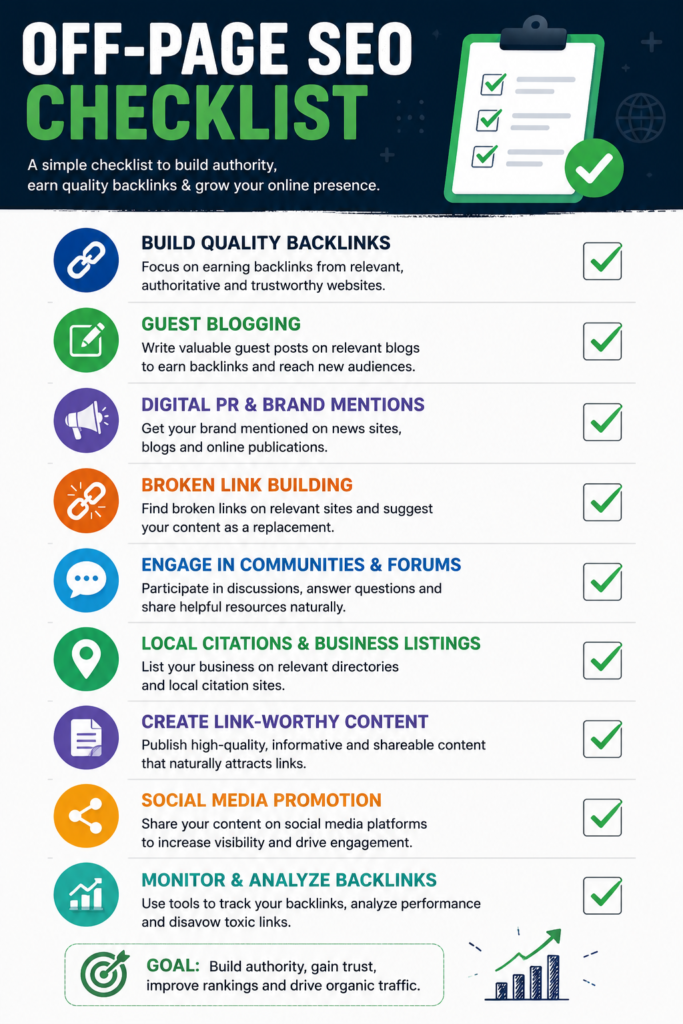
If you are a beginner, you don’t need to build hundreds of backlinks at once. Start with a simple and consistent approach.
Here is a basic Off-Page SEO checklist you can follow:
- Create useful and link-worthy content.
- Find relevant and trustworthy websites in your niche.
- Look for genuine guest blogging opportunities.
- Find relevant broken-link opportunities.
- Look for useful resource pages where your content could be a good addition.
- Monitor brand mentions and look for unlinked mentions.
- Participate in relevant online communities and provide helpful answers.
- Use SEO tools to research backlinks and competitors.
- Focus on quality and relevance rather than the number of backlinks.
- Avoid buying spammy backlinks or using automated link-building methods.
- Monitor your backlinks regularly.
Frequently Asked Questions About Off-Page SEO
What is Off-Page SEO in digital marketing?
Off-Page SEO refers to activities that happen outside your website to improve its visibility, reputation, and presence across the web. It includes activities such as link building, brand mentions, digital PR, and community engagement.
What are the main Off-Page SEO techniques?
Some common Off-Page SEO techniques include guest blogging, digital PR, broken link building, brand mentions, resource link building, creating link-worthy content, local citations, and community engagement.
Are backlinks important for Off-Page SEO?
Yes, backlinks are an important part of Off-Page SEO. However, the number of backlinks is not the only thing that matters. Relevant, trustworthy, and naturally earned backlinks can be more valuable than a large number of low-quality or irrelevant links.
What is the difference between On-Page and Off-Page SEO?
On-Page SEO focuses on optimizing elements within your website, such as content, headings, keywords, images, and internal links.
Off-Page SEO focuses on activities and signals outside your website, such as backlinks, brand mentions, digital PR, and other external activities.
In simple terms:
On-Page SEO = What you optimize on your website.
Off-Page SEO = What you build and do outside your website.
How can beginners start Off-Page SEO?
Beginners should start by creating useful, link-worthy content and understanding their target audience. Then, they can look for relevant guest blogging, resource-page, broken-link, brand-mention, and community opportunities.
Key Takeaways from Off-Page SEO
Off-Page SEO is not just about building as many backlinks as possible. It is about building your website’s reputation, visibility, and credibility outside your own website.
Backlinks are an important part of Off-Page SEO, but their quality and relevance matter more than simply focusing on numbers. Techniques such as guest blogging, digital PR, broken link building, brand mentions, resource link building, and creating link-worthy content can help you build a stronger online presence.
If you are a beginner, start slowly. Create useful content, focus on relevant opportunities, avoid spammy link-building practices, and build genuine relationships with other websites and communities.
Remember: quality over quantity. A few relevant and trustworthy links can be more valuable than hundreds of random backlinks.
Off-Page SEO takes time, but with consistent effort and a focus on providing real value, you can gradually build a stronger and more trusted presence across the web.
If you are new to SEO, you can also read my Beginner’s Guide to SEO to understand the fundamentals before diving deeper into Off-Page SEO.